
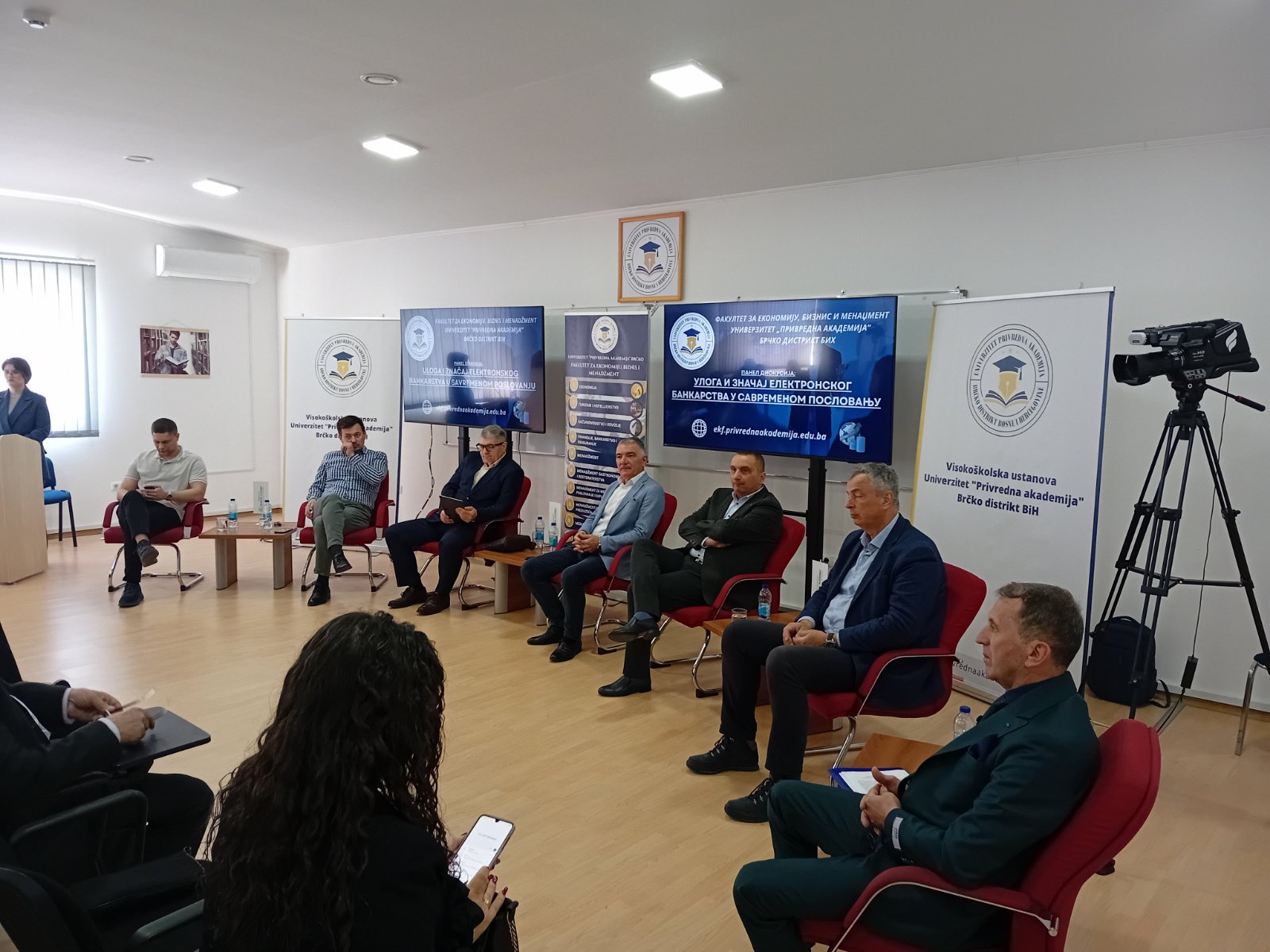

Doc. dr Marko Milić Profesor Fakulteta za ekonomiju, biznis i menadžment Univerziteta ” Privredna akademija” Brčko distrikt BiH , iznio je zaključke sa panel diskusije pod nazivom “Uloga i značaj elektronskog bankarstva u savremenom poslovanju” a čiji je moderator i bio sam profesor.
After the panel discussion held on April 18, 2026, at the Faculty of Economics, Business, and Management, University Privredna akademija Brčko District BiH, in Brčko, on the topic "THE ROLE AND IMPORTANCE OF ELECTRONIC BANKING IN MODERN BUSINESS",
the following were adopted
CONCLUSIONS
- Electronic banking today is not just a technological innovation; it represents a deep and comprehensive transformation of the entire financial system. It changes the way banks operate, the way clients make financial decisions, and how trust is built in a digital environment.
- Digitalno bankarstvo u BiH više nije trend već standard ponašanja potrošača. Rast od preko 1, 77 miliona aktivnih korisnika pokazuje promjenu navika, ali i promjenu očekivanja – brzina, dostupnost i jednostavnost postaju osnovni kriterijum izbora banke. Ključno pitanje više nije da li ulagati u digitalizaciju, već kako je učiniti održivom, inkluzivnom i sigurnom.
- The projects of the European Payments Initiative and the European Central Bank have an accelerated goal of creating a unified European payment system and improving digital infrastructure. Therefore, Europe is systematically building a sovereign and unified payment system. Standardization does not only mean technical harmonization but also strategic control over financial flows. For Bosnia and Herzegovina, the key question is not whether it will adapt to these flows, but how quickly and with what institutional capacities.
- Regulation is becoming a key factor for innovation. The first fully digital credit procedure shows that the technological capacity exists. However, without a clear and harmonized regulatory framework, development may remain partial. The balance between stability and innovation will be crucial.
- Artificial intelligence is becoming an integral part of banking processes, from creditworthiness assessment and fraud detection to personalized client consulting. In the coming period, the key dilemma will not be whether to use AI, but how to regulate it, make it transparent and ethical. AI can reduce operational costs, but also redefine the labor market.
- Without trust, there is no digital banking. Technology can enable faster and more efficient processes, but trust is built through transparency, data protection, and clear communication with clients. Security is becoming a competitive advantage, not just a technical obligation.
- In the next 3 to 5 years, banking will move towards full integration of digital services, personalization through generative AI, and the development of instant payment ecosystems. Banks that adapt to the "banking as a platform" model will have a strategic advantage.
- Bosnia and Herzegovina is in a phase of accelerated transition. There is a growth in users of digital financial services, as well as technological readiness of banks and examples of completely new digital products.
- A complete replacement of traditional banking with digital banking business models is not likely, given that personal contact still plays a significant role in certain segments of banking services and in building client trust.
PROFESSOR
Assoc. Prof. Marko Milić, PhD
Panel participants:
- Dejan Šoškić, PhD, full professor at the Faculty of Economics, University of Belgrade.
- Goran Radivojac, PhD, full professor at the Faculty of Economics, University of Banja Luka
- Edin Ajanović, Director of Ziraat Bank, Brčko District
- Milan Petrović, Director of the Information Technology Sector, Naša banka, a.d. Banja Luka
- Miladin Milošević, Director of the Insurance Sector at the company Brčko gas, Brčko District
- Nikola Duvnjak, Manager at the company Sloboprom, Brčko District